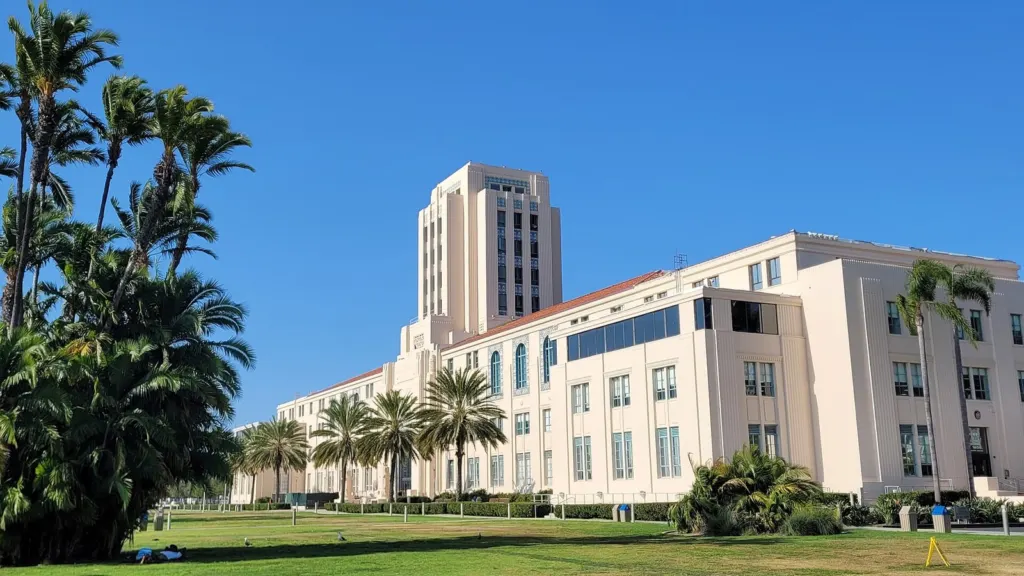
The San Diego County Administration Center. Photo: Matt Boulton, CC BY-SA 2.0, via Wikimedia Commons.
San Diego County’s half-cent sales tax for health care, child care, wildfire prevention and the Tijuana River sewage crisis is holding its lead as ballots are counted, and county leaders have started talking about how to spend the money.
Measure B, the San Diego Health and Safety Act, had 570,810 yes votes, or 52.91%, against 507,922 no votes in the latest Registrar of Voters update, NBC 7 reported. Supporters declared victory at a rally Monday, when about 185,000 ballots were still left to count, according to Axios San Diego. Results won’t be final until the county certifies the election.
Because Measure B reached the ballot through a citizens’ petition rather than a vote of the Board of Supervisors, it needs only a simple majority. Tax measures placed on the ballot by local governments for specific purposes need two-thirds.
Where the money would go
The tax would add half a cent to every dollar of taxable purchases in the county. Supporters estimate it would raise $400 million to $450 million a year. They have broken that down roughly this way, according to Axios:
- About $161.5 million a year for health care programs, including care for uninsured low-income residents
- About $96 million a year for the Tijuana River sewage crisis
- About $93.5 million a year for child care and children’s health and safety, including stipends for licensed providers and vouchers for families
- About $68 million a year for wildfire prevention, emergency response and public safety, including upgrades to the regional 911 system
By the measure’s percentages, 60% goes to health care and family services, 22.5% to sewage fixes and 17.5% to public safety and wildfire work, KPBS reported. A citizens’ oversight committee will help decide how the money is used, NBC 7 reported. It would be the first locally generated revenue stream dedicated to the sewage crisis, which has closed beaches in the South Bay for long stretches and made some residents sick.
Why now
County leaders pitched the tax as a way to replace federal money they expect to lose. Board Chair Terra Lawson-Remer has estimated the county faces about $300 million a year in lost federal funding for programs like Medi-Cal and CalFresh, according to KPBS.
“When the federal government cut funding for essential services, we didn’t back down,” Supervisor Paloma Aguirre said at Monday’s rally.
The measure had broad backing, from SEIU and firefighters unions to environmental groups and the child care advocacy group Children First San Diego. San Diego State political scientist Brian Adams told Axios that voters will support taxes when there’s no strong opposition campaign and the money goes to popular programs.
Opponents objected mostly to how long the tax lasts. Measure B has no expiration date. Mark Kersey, president of the San Diego County Taxpayers Association, told KPBS that without a sunset clause, voters never get a chance to revisit the tax.
When it takes effect
NBC 7 reported the tax is expected to take effect in April 2027. Lawson-Remer said Monday that funding would start flowing early next year.
Countywide sales tax measures have had a rough run recently. In 2024, voters rejected Measure G, a transportation tax, along with the city of San Diego’s Measure E.
Measure A also leads
Measure A, a county charter overhaul, was also passing, with 52.87% in the same update. It would create an independent ethics commission, budget analyst and program auditor reporting to the Board of Supervisors, and let supervisors serve three terms instead of two. It leaves the sheriff, district attorney and other countywide offices without term limits, and keeps the rule that supervisors live in the districts they represent.