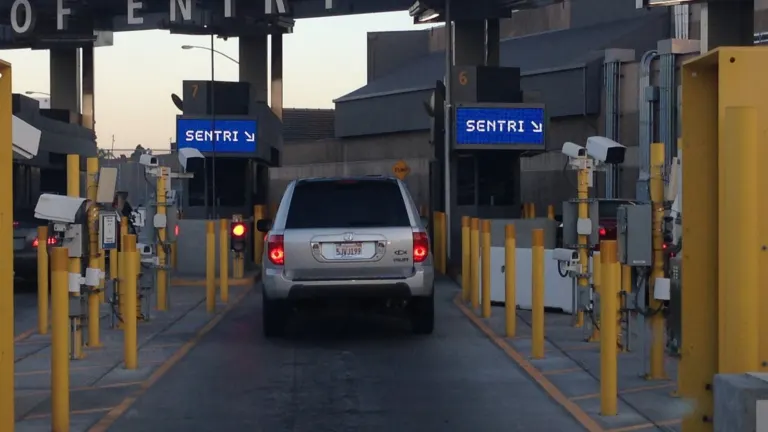
A CBP officer at the Otay Mesa port of entry, where U.S. and Mexican customs teams ran a five-day cargo inspection last month. Photo: U.S. Customs and Border Protection, public domain, via Wikimedia Commons.
U.S. and Mexican customs officers spent five days last month at the Otay Mesa cargo port checking high-value shipments for undervaluation, misclassification and false country-of-origin claims, according to accounts that cite both agencies. Negocios en la Frontera, writing Nov. 9, said U.S. Customs and Border Protection announced the results of Operation Trade Bridge on Nov. 6 and that the work ran Oct. 19 to 23 at Otay Mesa’s export cargo facilities in California. San Diego Red, in a Nov. 8 report based on a statement from Mexico’s National Customs Agency, also dated the operation to those five days and placed it at the Mesa de Otay port of entry between Tijuana and San Diego.
Both accounts said the operation focused especially on electronics and textiles. San Diego Red, citing ANAM, said Mexican officers ran inspections from the Mexican terminal while CBP worked on the U.S. side, and that the agencies compared U.S. export records, commercial paperwork and Mexican customs data in real time. Negocios en la Frontera said CBP’s field operations staff, specialists from its Centers of Excellence and Expertise, and investigators from Homeland Security Investigations took part, along with ANAM officials.
Over the five days, the binational teams unloaded and inspected 80 percent of the shipments selected for review, both outlets reported. Several of those shipments showed discrepancies or other issues that required more work, including questions about declared value, tariff classification, merchandise descriptions, quantities and origin. Negocios en la Frontera said CBP emphasized that the findings were still under review by CBP, ANAM and other participating agencies, and that it had not been reported that every irregularity had already led to a final penalty.
Follow-up will include checks of manufacturers, importers, exporters and the documents used to support declared origin, both accounts said. The outlets described the operation as part of a broader effort to stop transshipment schemes and improper claims for preferential tariff treatment under the United States-Mexico-Canada Agreement, without giving a count of shipments that will face formal action.
 By