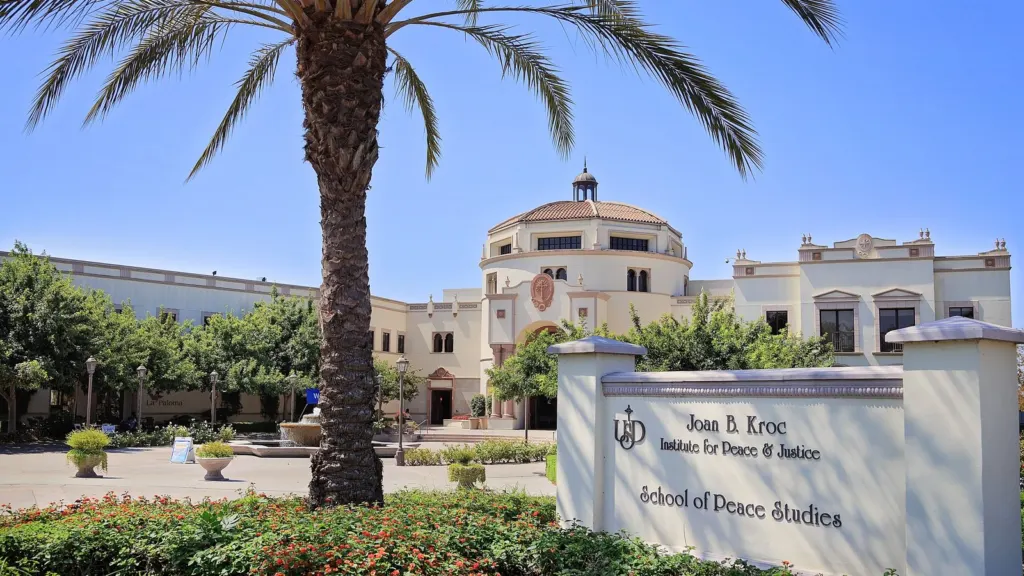
The Joan B. Kroc Institute for Peace and Justice at the University of San Diego. Photo: Krdobyns, CC BY-SA 4.0, via Wikimedia Commons.
Joan Kroc died in Rancho Santa Fe in October 2003, and within weeks people learned how much money she had left behind and where it was going. Most of her fortune came from McDonald’s, the chain her husband Ray Kroc built. A lot of it stayed in San Diego, and you can still visit much of what it paid for.
Here are five places where her money is still at work, and where to go to see them.
1. The Padres, 1984 to 1990
Ray Kroc bought the Padres in 1974 and kept the team from leaving San Diego. When he died in January 1984, Joan took over as owner. That fall the Padres won their first National League pennant and reached the World Series. She ran the club until 1990, when she sold it to a group led by television producer Tom Werner.
It was the shortest of her San Diego chapters, and the most public. It also overlapped with the arrival of Tony Gwynn, who won his first batting title in 1984.
2. The Kroc Institute and School of Peace Studies at USD
The building in the photo above started with a lunch. Alice Hayes, president of the University of San Diego from 1995 to 2003, wrote in a remembrance for the Kroc School’s magazine that Kroc had turned down a request to help pay for the 1996 presidential debate on campus but quickly offered $3 million for interest-free student loans.
When the two looked through thank-you notes from the students who got those loans, the conversation turned to bringing more international students to campus and teaching people how to work across cultures. “That’s what the world needs! Let’s work on that!” Hayes recalled Kroc saying.
Kroc gave $25 million for the Joan B. Kroc Institute for Peace and Justice, which broke ground on Oct. 6, 1999. Hayes wrote that Kroc wanted to name it for Gandhi, but the university asked to put her name on it. Her estate later left $50 million to endow the Joan B. Kroc School of Peace Studies, which Hayes described as the first stand-alone school of peace in the country.
To visit: The institute sits on the USD campus off Linda Vista Road and hosts public lectures through the school year.
3. The Kroc Center in Rolando
Kroc said a tour of San Diego convinced her that the city needed a safe gathering place for children, with real facilities and trained staff. She gave the Salvation Army $90 million in capital and endowment money to build one, according to the Kroc Center’s own history page.
The result opened in 2002 on 12.4 acres at 6845 University Ave. It has an NHL-size ice rink, three pools, a 540-seat theater, a 30-foot climbing tower, a gym, a preschool and a charter school. It serves East San Diego, La Mesa and Lemon Grove.
She was pleased enough with it that she left the Salvation Army about $1.5 billion to build more. There are now 26 Kroc Centers around the country, all modeled on the one in Rolando.
To visit: The center is open to members and the public. Call 619-287-5762.
4. KPBS and NPR
On Nov. 6, 2003, NPR announced a bequest of more than $200 million from Kroc’s estate. Its press release called it believed to be the largest monetary gift ever received by an American cultural institution. Most of it went into NPR’s endowment.
The same release noted that San Diego’s own station, KPBS, received $5 million from her. NPR’s president at the time, Kevin Klose, said her ties to KPBS helped her understand and value NPR.
5. Father Joe’s Villages
Years before the USD and Rolando gifts, Kroc helped Father Joe Carroll build the St. Vincent de Paul Joan Kroc Center downtown, which opened in 1987 with shelter, meals, a medical clinic, child care and job training under one roof, according to Father Joe’s Villages. The building still carries her name. It is one of the less visible pieces of her giving and one of the most used.
What she left behind
San Diego has a short list of people whose money shaped what the city has, from Ellen Browning Scripps in La Jolla to John D. Spreckels downtown. Kroc belongs on it. Unlike them, she made her biggest bets late and mostly through other institutions, and left them to run things after she was gone.
More profiles of the people who built San Diego’s businesses and institutions are in our Business Leaders section.