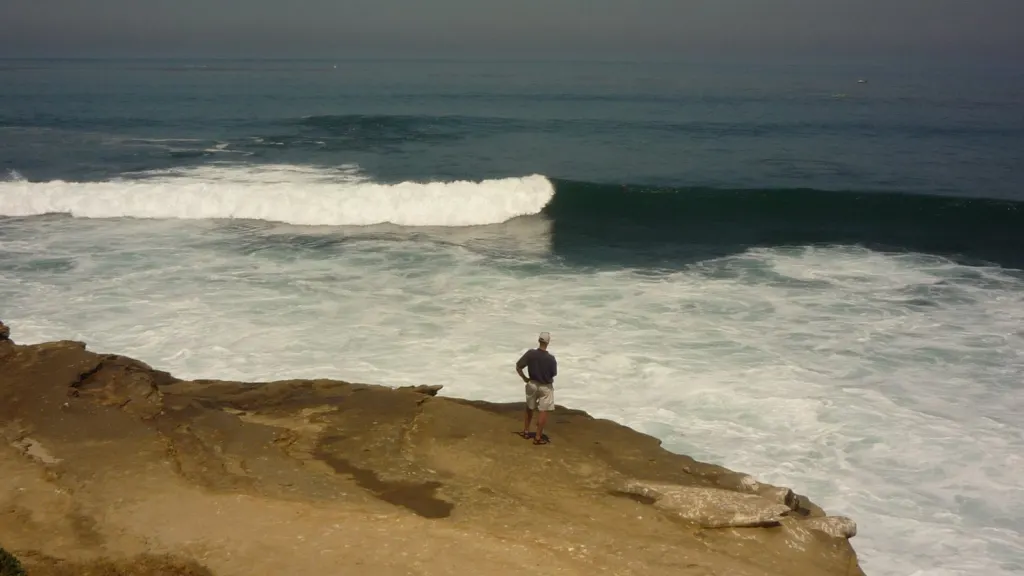
High surf breaking off the reef at La Jolla. Photo: Colin W, CC BY-SA 3.0, via Wikimedia Commons.
The big surf that closed piers and chewed at the bluffs over the weekend is not done with San Diego. The National Weather Service renewed its high surf advisory early Tuesday, calling for breaking waves of 6 to 10 feet on west-facing beaches and very strong rip currents until 4 a.m. Wednesday.
A fresh swell arrived overnight. The Scripps Institution of Oceanography’s Torrey Pines Outer buoy, which sits off the coast and feeds most local surf forecasts, recorded a significant wave height of 3.16 meters, about 10.4 feet, at 1:30 a.m. Tuesday. The waves were coming from the west at 18-second intervals, the long-period kind that carries a lot of energy onto the beach. On Monday the same buoy had been reading between roughly 7 and 9 feet, according to its public data feed.
The advisory covers San Diego and Orange County coastal areas and warns of dangerous swimming and surfing conditions, localized beach erosion and minor coastal flooding during high tides.
Water ran more than a foot above the tide tables
The surf has been arriving on top of high water. At the NOAA tide gauge on Scripps Pier in La Jolla, the water level topped out at 6.31 feet above the low-water baseline at 10:24 a.m. Saturday, Nov. 14. The predicted high tide that morning was 4.86 feet, so the sea ran about 1.4 feet higher than the tide tables called for, according to the station’s preliminary readings.
The gap held through the weekend. Sunday’s peak reached 5.73 feet against a forecast high of 4.47, and Monday’s 5.34 feet against 4.08. Water levels that high, with big sets on top of them, are what push waves up beach stairs and into parking lots.
That matches what showed up along the coast. Over the weekend, caution tape closed off part of Sunset Cliffs because of erosion, and the Crystal Pier in Pacific Beach was shut to the public as a precaution, NBC 7 reported. Earlier this month the same La Jolla gauge and the one in San Diego Bay set record highs during king tides.
When the water is highest this week
NOAA’s predictions for La Jolla put Tuesday’s high tides at 4:35 a.m. and 2:29 p.m., both near 3.8 feet. Wednesday morning’s high, at 4:55 a.m., is a little higher, at 4.16 feet, just before the advisory is set to expire. If the swell and surge behave the way they did over the weekend, actual water levels could again run above those numbers.
For anyone heading to the coast to watch, the usual precautions matter more than usual this week: stay off wet rocks and jetties, keep back from bluff edges, and don’t turn your back on the water.
Monday night’s rain adds a second reason to stay out. The county’s general rule is to avoid ocean contact for 72 hours after rainfall because runoff carries bacteria to the shore. Our guide to checking San Diego beach water quality explains where to look before you go in.
Cities along the coast are already bracing for a wetter winter. Carlsbad has been stacking boulders under south Carlsbad Boulevard ahead of El Niño storms. Forecasters will update the advisory before it expires Wednesday morning. Updates on the coast and the bluffs are in our Environment & Coast section.
More in Environment & Coast
County’s new pollution chief joins a Saturday health fair as federal air report draws comment
 By Gabriel Serrano ·
Tijuana River sewage chemicals can reach La Jolla’s air, study finds
By Gabriel Serrano ·

San Diego and La Jolla tide gauges hit record highs, with more king tides ahead
By Gabriel Serrano ·