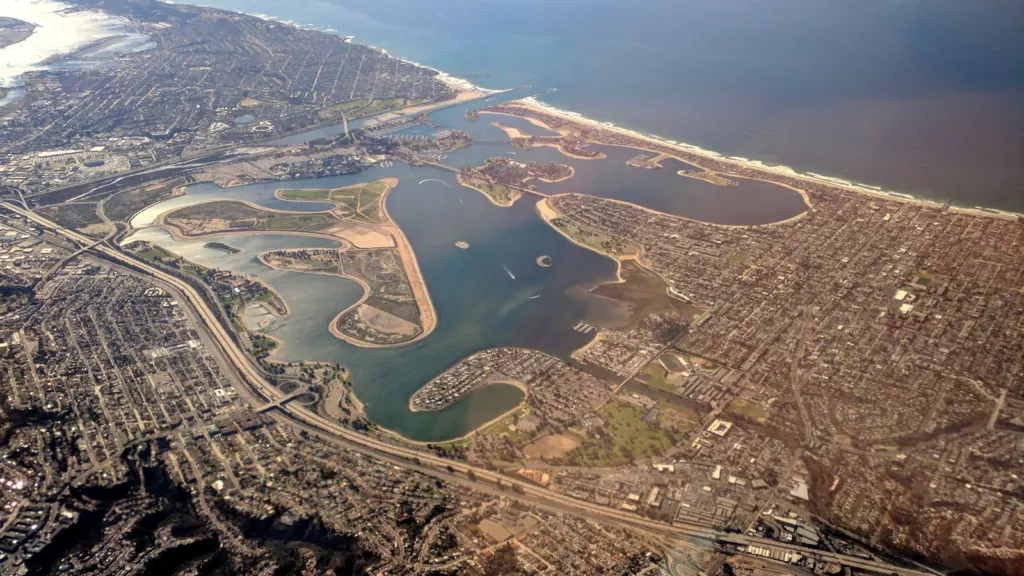
Mission Bay from the air. De Anza Cove and Campland sit at the bay's northeast corner. Photo: Alfred Twu, CC0, via Wikimedia Commons.
San Diego’s long-range plan to turn Campland on the Bay into salt marsh cleared the City Council on Tuesday, when members accepted the California Coastal Commission’s changes to the De Anza Natural plan for the northeast corner of Mission Bay. The vote was unanimous, CBS 8 reported.
The plan now goes back to the Coastal Commission for final certification. Nothing gets dug yet. De Anza Natural is a policy document, an amendment to the Mission Bay Park Master Plan, and each piece of it will need its own project, environmental review and permits. But Tuesday’s vote settles the rules those projects have to follow, and some of the Commission’s changes are specific about what people will see along Rose Creek and De Anza Cove.
What the plan covers
The amendment covers about 314 acres of land and 191 acres of open water, according to the Coastal Commission staff report prepared for its August hearing. Inside that line are the Kendall-Frost Marsh Reserve and Northern Wildlife Preserve, Campland on the Bay, the Pacific Beach Tennis Club, the McEvoy athletic fields, Mission Bay Golf Course, a vacated mobile home park, the Mission Bay RV Resort, and public lawns, beaches and parking.
The headline number is habitat. As modified, the plan shows more than 260 acres of wetlands, plus about 36.7 acres of uplands and buffers, with a combined wetland and upland total of 261.8 acres to be refined later. That requires removing Campland, which sits on roughly 44 acres west of Rose Creek.
Camping moves rather than disappears. The plan sets aside about 48.5 acres east of Rose Creek, on the De Anza peninsula, for lower-cost visitor accommodations, up from the roughly 30 acres there now. The Commission noted that the two RV parks together use about 74 acres today, so the new layout still means less overnight space. The city has told the Commission it expects to build the new camping area first, before Campland closes, to keep as many sites open as possible during the switch.
What the Coastal Commission changed
Commission staff recommended rejecting the city’s version as submitted and approving it with modifications, and those changes are what the council accepted. Among them:
- Tent camping has to be part of the mix. The city’s draft talked about RV parks. The Commission wrote tent camping in, citing the need to keep the coast open to visitors at lower price points. The staff report lists current winter rates at Campland of $55 to $364 a day and $75 to $105 at the Mission Bay RV Resort.
- Eelgrass gets protection. The city’s plan would fill open bay water that now holds eelgrass to build marsh. The Commission added limits on when that kind of conversion is allowed and on how much mitigation credit it can earn.
- The Rose Creek channels need proof first. The plan shows two new channels cut through the De Anza peninsula to send some of Rose Creek’s flow through De Anza Cove. Staff wrote that no technical studies yet show those channels would work, so they will have to be studied when a project is proposed.
- Tribal consultation and cultural resources. The Commission required consultation with Native American tribes and resource surveys before project approvals, tied to the planned interpretive nature center.
- Shoreline access stays public. Private leaseholds can’t encroach on public shoreline access, and public improvements tied to a private redevelopment have to be built at the same time.
“Now, with this plan in hand, I am committed to delivering a revitalized and resilient Mission Bay,” Council President Joe LaCava said in a statement before the hearing, Times of San Diego reported. The outlet also reported that the Campland and Mission Bay Boat & Ski Club leases remain in place for now.
Why it took this long
The Mission Bay Park Master Plan was first certified in 1994 and last amended in 2002, and the park is still an “area of deferred certification,” meaning the Coastal Commission, not the city, keeps permit authority there. The De Anza amendment was filed as complete in May 2025 and got a one-year extension before the Commission’s Aug. 14 hearing. The city’s council preview describes it as a framework for the next 20 to 30 years.
Water quality is part of the case. The shorelines at De Anza Cove and Campland are listed as impaired for indicator bacteria, the Rose Creek mouth for eutrophication and lead, and Rose Creek itself for a long list of pollutants, according to the staff report. (Our guide to checking San Diego beach water quality explains how those bacteria advisories work.) The restored marsh and channels are meant to help. Sea-level rise is the other driver; we covered the record tide readings at San Diego and La Jolla earlier this month.
Once the Commission certifies the amendment, the next real step is a general development plan for the area, where acreage for each habitat type, the channel design and the new campground layout get worked out. More on the bay and the shoreline is in our Environment & Coast section.
 By