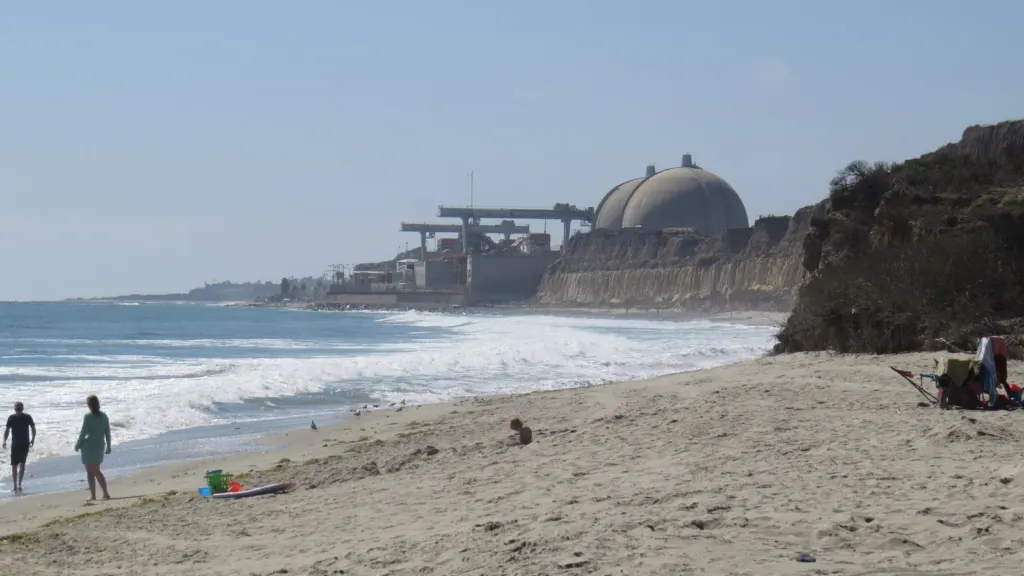
The San Onofre Nuclear Generating Station's containment domes above the beach in 2014. Photo: Luke Jones from Anchorage, CC BY 2.0, via Wikimedia Commons.
The steel canisters holding San Onofre’s spent nuclear fuel were licensed for a 40-year standard. Rep. Mike Levin wants every new one approved by federal regulators to be built for 100.
Levin, the Democrat who represents California’s 49th District, reintroduced the 100 Year Canister Life Act on Nov. 18. The bill would give the Nuclear Regulatory Commission 18 months to write rules requiring newly approved spent fuel storage systems to meet a minimum 100-year safety standard. Before issuing or renewing approvals for covered storage systems and facilities, the NRC would have to find that they can safely hold spent fuel for at least a century.
The reason is simple arithmetic. About 3.6 million pounds of spent fuel, more than 1,600 tons, still sit at the shuttered San Onofre Nuclear Generating Station, roughly 100 feet from the Pacific, according to Levin’s office. The plant stopped generating power more than a decade ago. There is still no federal site to take the waste.
Where the cleanup stands
Much of San Onofre is already gone. In the 2026 SONGS Report released Oct. 28 at a news conference at the plant with Southern California Edison President Steve Powell, Levin’s office said all spent fuel has been moved from cooling pools into dry storage, 52 of the site’s 62 structures have been demolished, and more than 700 million pounds of material have been hauled away. Both containment domes, the landmark spheres beside Interstate 5, are expected to be taken down by the end of 2027, with major decommissioning work on track to finish by the end of 2028.
What will remain after that is the storage pad: the canisters themselves, in dry storage a short walk from the surf line. With the domes gone, the waste will be the plant’s last real footprint, and the question of how long those canisters must hold up becomes the main safety question left at the site.
“Until we can move that waste, we need to make sure it’s stored as safely as possible,” Levin said in the Nov. 18 announcement. “My bill would strengthen federal safety standards to better reflect the reality that communities like ours have been forced to live with this waste for decades.”
What the bill would and would not do
The 100-year standard comes straight from the SONGS Task Force that Levin convened in 2019. Its 2020 report recommended federal legislation requiring a design life of at least 100 years for nuclear waste canisters.
The bill is narrower than it might sound. It covers newly approved storage systems and renewals; it does not order the canisters already at San Onofre to be swapped out. And Levin’s office notes it “would not require the NRC to extend the length of any licenses,” which matters to neighbors who worry a longer-lived canister becomes an excuse to leave waste on the coast longer.
The bigger lever is still moving the fuel. Levin’s office says he has helped secure nearly $250 million nationally for spent fuel management and removal, including more than $100 million in fiscal 2026, money that has gone toward finding off-site storage, research and certification of the Atlas railcar built to carry spent fuel. In July, the governors of Utah, Tennessee, Oklahoma, Louisiana and Idaho signed agreements to explore hosting Department of Energy “Nuclear Lifecycle Innovation Campuses” that could someday accept fuel from closed plants like San Onofre.
Orange County Supervisor Katrina Foley, speaking at the October event, tied the issue to the coastline itself. “With rising sea levels, coastal erosion and seismic risks, we cannot afford to let this issue languish,” she said.
That concern is familiar this month in San Diego County, where Thanksgiving week king tides and high surf are testing beaches and bluffs, and where cities like Carlsbad are armoring coastal roads before El Niño. More of our coverage is in Environment & Coast.
The bill is a reintroduction, meaning an earlier version stalled. Its next step is committee review in the House, where it would need a hearing before any floor vote.
More in Environment & Coast

Thanksgiving king tides top 7 feet in San Diego Bay; here’s when, and what the city is doing
San Diego council accepts Coastal Commission changes to De Anza Natural, the plan to turn Campland into marsh
 By Gabriel Serrano ·