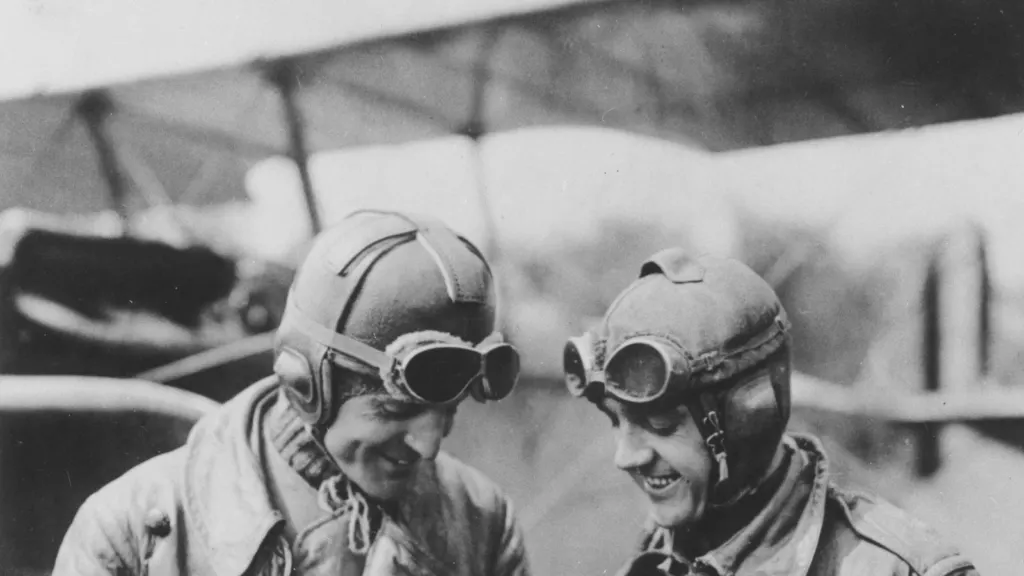
Maj. Reuben H. Fleet, with Lt. George Boyle, during the Army's first airmail service in 1918. Photo: Smithsonian Institution from United States / Wikimedia Commons, No restrictions
In 1935 an East Coast aircraft maker packed up its Buffalo, New York, operation and moved it across the country to San Diego, bringing 411 engineers and managers with it. The man who made that call, Reuben H. Fleet, wanted weather he could fly in year-round. Within a decade his company had 41,000 people on its San Diego payroll, and the city was never the same.
Fleet’s name is best known today from the science center in Balboa Park. The story behind it starts in a Washington timber town and runs through the first U.S. airmail flight.
From Montesano to the Army Air Service
According to the Fleet Science Center’s biography, Reuben Hollis Fleet was born March 6, 1887, in the Grays Harbor area of Washington Territory, near Montesano. He graduated from Culver Military Academy in Indiana in 1906, went home to work in his family’s timber and real estate businesses, served as an officer in the Washington National Guard and in 1915 was elected to the state Legislature as its youngest member.
His aviation career began in San Diego. The Army sent him to Rockwell Field on North Island for flight training, and he earned his military aviator’s wings there in 1917, soon after being commissioned a major in the Signal Corps. He directed aviation training in Washington, D.C., trained as a flight instructor in England and later served as the Army Air Service’s chief contracting officer at McCook Field in Dayton, Ohio.
In 1918 he was given the job of organizing the nation’s first airmail service. The San Diego History Center notes he commanded the unit that flew the inaugural load of U.S. mail between New York and Washington.
Building Consolidated
Fleet left the Army in 1922 and worked briefly as general manager of Gallaudet Aircraft. In 1923 he founded Consolidated Aircraft Corp., buying the training-plane designs of Dayton-Wright from General Motors and renting the Gallaudet factory in Rhode Island. A year later he moved to Buffalo, leasing space in a government-built Curtiss plant, and bought Thomas-Morse Aircraft and the Hall Aluminum Aircraft Co.
The company wanted to build and test seaplanes, and San Diego offered better weather for developing and flight-testing new aircraft, the History Center says, and Fleet moved the company west in 1935.
The wartime boom
Times were lean at first. Then the buildup to World War II arrived. Consolidated became the world leader in military training planes and built more seaplanes than all other flying boat makers combined, according to the science center, including the PBY Catalina. Its B-24 Liberator bombers were built in greater numbers than any other aircraft ever produced.
Employment in San Diego peaked at 41,000 in 1943. Workers came from the South and Midwest to take jobs at the plant, and the History Center credits Consolidated as the place where the term “Rosie the Riveter” was coined. Fleet himself had already stepped away: he sold his stock in the company three weeks before Pearl Harbor. Consolidated later became Convair, eventually a division of General Dynamics.
The company’s alumni seeded the city’s later technology economy. The History Center lists former Convair engineers who went on to lead San Diego firms, among them Walter Zable at Cubic Corp. and Bill Ivans at Cohu.
The space theater
Fleet’s lasting gift to the public came later. He and his family provided the essential gift that created the Reuben H. Fleet Space Theater and Science Center in Balboa Park, now the Fleet Science Center at 1875 El Prado.
He was inducted into the International Air & Space Hall of Fame at the San Diego Air & Space Museum in 1965, was named “Mr. San Diego” in 1968 and entered the National Aviation Hall of Fame in 1975. He died in San Diego on Oct. 29, 1975, at 88.
Fleet belongs with the builders profiled in our Business Leaders series, from Alonzo Horton, who bought downtown for $265, to John D. Spreckels. Planning a trip to the park? See our guide to Balboa Park’s Residents Free Tuesdays.