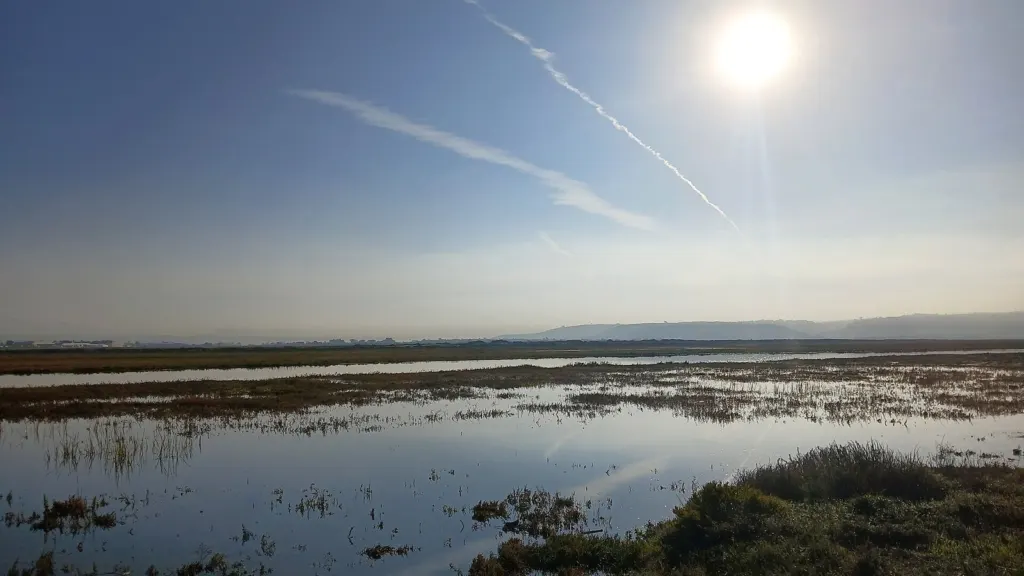
The Tijuana River Estuary. Photo: Issac I Navarro, CC BY 4.0, via Wikimedia Commons.
San Diego County’s first pollution crisis chief is set to appear at a community fair in Imperial Beach this Saturday, where a federal health report on Tijuana River air is on the table. Residents can comment on it through Nov. 21.
The county, federal agencies and local partners are hosting a Healthy Community Fair on Saturday, Nov. 14, from 10 a.m. to noon at the Imperial Beach Library, 810 Imperial Beach Blvd., the county announced. Spanish and English interpreters will be there. Partners include the federal Agency for Toxic Substances and Disease Registry (ATSDR), the county Air Pollution Control District, San Diego State University, UC San Diego and the Tijuana River Coalition.
Who is running the response
The county hired Bridget Premont last month as its first pollution crisis chief, a job approved in January. Her duties include coordinating infrastructure fixes with federal, state and local agencies, responding in real time when sewage spills occur, keeping a public funding dashboard and chairing a county task force. Premont, a former U.S. diplomat who lives in Imperial Beach, told KPBS that she wants long-term planning instead of the “stopgap way” governments have handled the crisis. She said she will be at the fair.
She also said engineers agree the most cost-effective fix is in Mexico, but the county can’t wait 10 or 15 years. Next steps on the county’s side include design and permitting for a second phase of work at the Saturn Boulevard hot spot and a feasibility study for a larger treatment facility.
What the air report says
Information on ATSDR’s report on hydrogen sulfide and odors in the Tijuana River Valley, released for public comment Sept. 23, will be available at the fair. Its main findings, from the report itself:
- Hydrogen sulfide in 30-minute samples was above the odor threshold at all four monitoring sites up to 93% of the time, enough that odors alone can cause headaches, nausea, irritation and other symptoms.
- At the Leon Avenue site, the highest 30-minute average, in September 2024, hit 3,021.5 parts per billion, above the 2,000 ppb level where health effects have been seen. It topped that mark 0.04% of the time. ATSDR said levels were likely also high at Berry Elementary across the street, which had no monitor until October 2024.
- Longer-term exposure is not expected to cause harm beyond odor-related symptoms.
ATSDR is taking comments at OCHHAPublicComment@cdc.gov through Nov. 21. The fair will also cover the county’s Tijuana River Valley Economic Impact Study. Organizers expect results later this year from a second CDC household survey, called CASPER.
 By