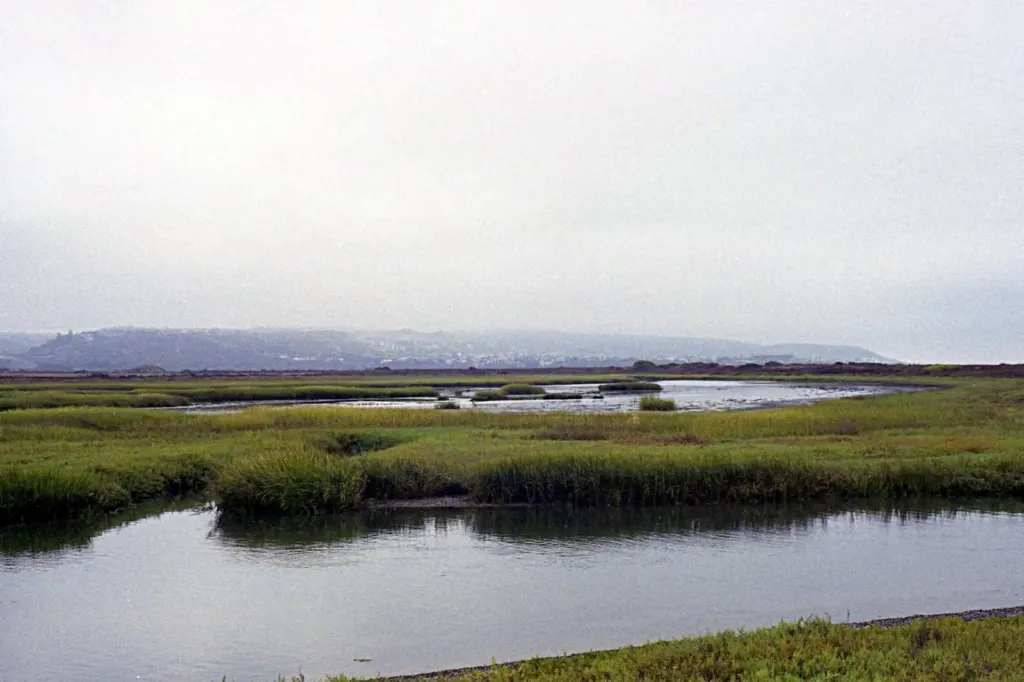
Photo: Osbomb via Wikimedia Commons, CC BY 2.0
As forecasters warn of a potentially strong El Niño winter, the binational effort to stop sewage from flowing out of the Tijuana River and onto South County beaches is moving from planning into heavy construction. A contract worth more than half a billion dollars has been awarded to expand the border treatment plant, a key pipeline in Tijuana has been finished and work has started on the second phase of the river diversion gates. But for Imperial Beach and the shoreline south of it, the water is still not safe.
A $552 million contract for the South Bay plant
The U.S. Section of the International Boundary and Water Commission issued a revised contract award on Oct. 13 to PCL Construction, which is working in a design-build team with the engineering firm Stantec, Engineering News-Record reported. The revised award raises the contract to $552 million for expansion of the primary treatment facilities at the South Bay International Wastewater Treatment Plant in San Ysidro.
The plant was expanded to 35 million gallons per day in August 2025. The next expansion is designed to take it to 50 million gallons per day. “Substantial completion is scheduled for May 2031,” Jeff Newman, PCL’s operations manager, told ENR, adding that facilities will be brought online as they are completed during the contract.
The work includes a new headworks, a new chemical system, two more primary sedimentation tanks, a new sludge thickening and storage system and a new electrical building. Newman told ENR that shoring, dewatering and excavation were expected to begin within weeks.
There is a significant catch. The $552 million covers primary treatment only. The broader expansion also calls for 10 new secondary sedimentation tanks and seven new activated sludge tanks, and IBWC spokesman Frank Fisher told ENR that additional funding will be required before that secondary treatment work can be awarded.
Progress on the Mexican side
The U.S. Environmental Protection Agency’s third-quarter update, released Sept. 30, laid out where projects stand under the agreements the United States and Mexico have reached to end the crisis, including Minute 333.
- Parallel Gravity Line: The pipeline that carries Tijuana’s sewage toward the San Antonio de los Buenos treatment plant was completed in August 2026, according to the EPA.
- Tijuana River Gates: The project is designed to keep an estimated 5 million gallons per day of flows out of the river. Phase 1, paid for by Mexico, has eight of 11 segments complete. Phase 2, funded through EPA’s Border Water Infrastructure Program, began construction in September and is on track for early 2027.
- Pump Station 1: Construction began in April on a project meant to prevent catastrophic discharges caused by unreliable pumping, with completion targeted for November 2027.
- Effluent relocation: A project to divert 10 million gallons per day of treated wastewater from the La Morita and Arturo Herrera plants away from the river and to the Rodríguez Reservoir is scheduled to be finished by December 2027.
- Antiguo Force Main: Urgent repairs have begun on the 14,000-foot pipe, ahead of its full replacement.
The EPA also said U.S. crews had cleared about 16,622 feet of the river’s pilot channel by late September, removing vegetation and repairing embankments ahead of the rainy season.
“Once again, this latest public update highlights the urgent progress being made to fully implement last year’s agreement,” EPA Administrator Lee Zeldin said in the release. IBWC Commissioner Chad McIntosh said the agency is “moving with the urgency this crisis demands to protect public health, restore access to San Diego’s beaches, and end the foul odors affecting communities near the Tijuana River.”
The El Niño worry
Rain is the biggest threat. Storms send huge volumes of untreated runoff and sewage down the river, overwhelming collection systems on both sides. The EPA said it and the IBWC have begun coordinating with agencies in San Diego and Tijuana to check the condition of infrastructure, including the Rodríguez Reservoir, ahead of a winter that could bring heavy rain and flooding risk from October through April.
Beaches remain closed
None of this has reopened the southernmost beaches yet. The shoreline at Border Field State Park and the Tijuana Slough National Wildlife Refuge has been under closure since October 2025, according to county beach water quality listings reported in early October, and Imperial Beach’s municipal beach has been under advisory.
The county posts updated beach closures and advisories at sdbeachinfo.com. Surfers, swimmers and families should check before going in the water, especially after rain, when bacteria levels typically spike.
The federal government says border treatment capacity has more than doubled and dry-season flows are down sharply from 2022–2024 levels. For South Bay residents who have lived with closed beaches and the smell of sewage for years, the measure that matters will be whether this winter’s storms bring the same closures as before.
 By