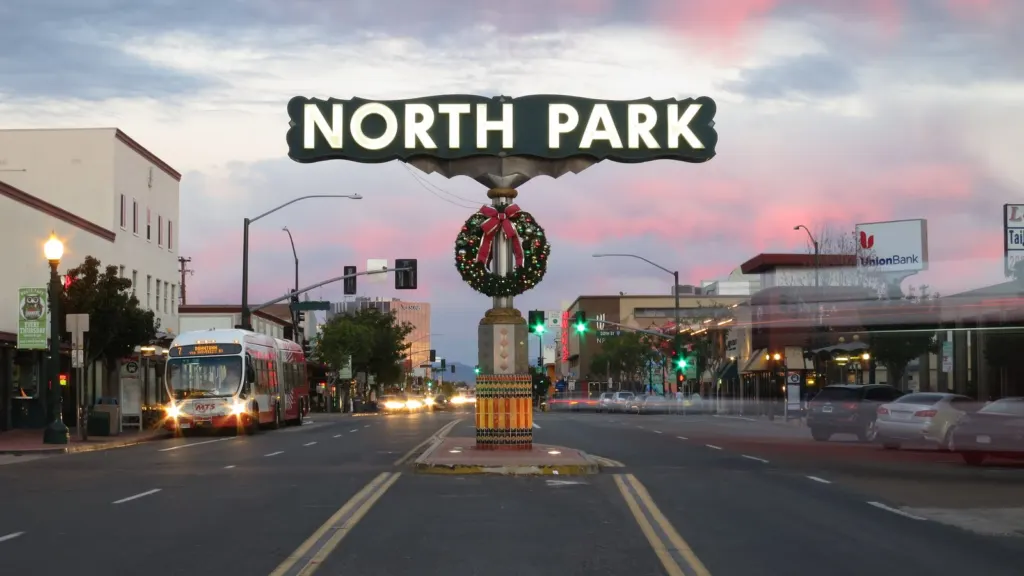
The North Park sign at University Avenue and 30th Street. North Park led the city in permitted homes in 2025. Photo: Jlantzy, CC BY-SA 3.0, via Wikimedia Commons.
The City of San Diego issued permits for 7,630 new homes in 2025, down 13% from the year before and 21% below its 2023 high, according to the city’s 2026 Annual Report on Home Permitting, which the City Planning Department posted this month.
Of those, 2,050 were deed-restricted as affordable to very low-, low- or moderate-income households, about 27% of the total. That is nearly double the 1,061 affordable homes permitted in 2024, even as overall permitting slid.
The report is the city’s yearly check on its state housing target, and the gap is widening. Five years into the 2021-2029 cycle, San Diego has permitted 36,533 homes, or 34% of the 108,036 the state’s Regional Housing Needs Assessment assigns it. To hit the target, the city would need 71,503 more by 2029, the report says.
Five years of permits, by the numbers
The report’s year-by-year totals show a jump in 2023 that has not held:
- 2021: 5,032 homes
- 2022: 5,396
- 2023: 9,693
- 2024: 8,782
- 2025: 7,630
The city’s own benchmark is an average of about 13,505 homes a year over the eight-year cycle. Spread the remaining 71,503 over the four years left, 2026 through 2029, and the pace would have to reach nearly 17,900 a year, more than double last year’s total and well above the city’s best year so far.
Affordable homes are further behind. The city has permitted 6,831 deed-restricted affordable homes since 2021, against a cumulative benchmark of 40,125 by the end of 2025, or an average of 8,024 a year.
Planning Director Heidi Vonblum wrote in the report’s introduction that the lower count “reflects a broader slowdown in housing construction occurring across California and the nation as economic conditions and development costs continue to change,” and that San Diego “continues to lead large cities across the state in housing permitting.”
Where the homes went
North Park led all community plan areas with 1,066 permitted homes in 2025, followed by Uptown (611), Mission Valley (601), Encanto Neighborhoods (503) and Linda Vista (483). For affordable homes, Navajo topped the list with 317, ahead of Encanto Neighborhoods (212), North Park (191) and Mission Valley (188).
The city’s incentive programs did much of the work. The Affordable Homes Density Bonus Program accounted for 2,172 permitted homes, and the Complete Communities Housing Solutions Program for 2,165, its highest year since 2021. Permits for accessory dwelling units totaled 2,165, slightly below the 2,285 permitted in 2024.
Most new homes still carry no income restriction. In 2025, 33% of units in multifamily projects were deed-restricted, compared with 16% of ADUs and 1% of single-family homes.
Recent projects show what the affordable side looks like on the ground, from the 97 affordable homes at Hillcrest Hall to the Housing Commission’s $22 million offer for new rental projects. More city coverage is on our Local News page, with housing finance on the Finance page.
The report also includes a fair housing assessment that maps where homes were permitted against the state Tax Credit Allocation Committee’s opportunity areas. With four years left in the cycle, the city’s own programs, including the Affordable Home Development Master Plan and Neighborhood Homes for All of US that Vonblum cites, would have to support a much faster pace than any year so far.
 By