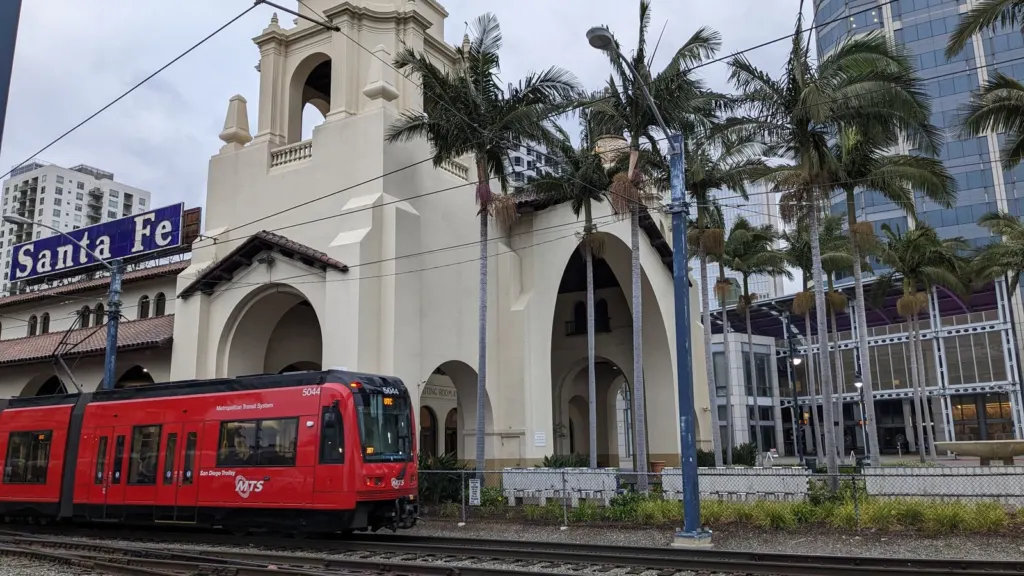
A San Diego Trolley passes the Santa Fe Depot downtown. Photo: Mds08011, CC BY 4.0, via Wikimedia Commons.
The Metropolitan Transit System released a new economic impact report on Nov. 19, and the number it is leading with is a household one: San Diego County riders save an estimated $570 million a year by taking buses and the Trolley instead of driving. The figure comes from a study MTS commissioned from the economic research firm ECOnorthwest, and the full report shows how that number was built and where its limits are.
The MTS release says the agency generates about $1.94 in economic activity for every dollar it spends, supports nearly 4,800 jobs and $940.4 million in regional economic output, and adds $527.9 million in value to the county economy through wages, business income and taxes. Those are agency-wide figures. The savings estimate is the part that speaks directly to a family budget.
Where the $570 million comes from
The 78-page report splits the savings into two pieces. About $305.4 million is the variable cost of driving that riders avoid, priced at roughly 35 cents a mile. That rate combines a San Diego gas price of $6.15 a gallon for the second quarter of 2026, an average fuel economy of 25.6 miles per gallon, and 11 cents a mile for maintenance, repairs and tires.
The other $265.1 million is the fixed cost of cars that households would otherwise buy. The report applies $7,972 a year per avoided vehicle, drawn from AAA’s ownership cost figures after removing fuel and maintenance so the same expense is not counted twice. MTS puts the number of vehicles riders do not have to buy at about 33,250, and the miles of driving taken off regional roads at about 867 million a year.
MTS says about 80% of the savings, more than $450 million, goes to households earning under $70,000 a year.
What the estimate leaves out
Three details matter for anyone weighing the number.
First, it counts only work and school trips. Medical visits, shopping, recreation and other travel are not included, which the agency’s own report summary page notes.
Second, it is a modeled estimate, not a count. The report says no dataset directly shows how many San Diego households own fewer cars because MTS exists. ECOnorthwest built a travel-behavior model from SANDAG’s 2023 on-board rider survey, Census data and school enrollment records, then estimated what riders would do if transit disappeared: drive a car they already own, buy one, carpool, walk or bike, or leave the region. The model was scaled to the 249,499 unique adult passholders MTS reported in September 2024, and the report says that count likely overstates how many riders see the full savings, because many passholders ride only occasionally.
Third, the calculation table lists avoided driving and ownership costs. Fares riders pay are not shown as a deduction in it. Adult fares rose to $3 on Oct. 1, as we reported last month, so a regular rider’s real savings depend on what they pay to ride.
The report also notes a much larger benchmark from the American Public Transportation Association, which estimates that a San Diegan who replaces driving with transit can save about $14,929 a year. ECOnorthwest chose not to apply that figure to every rider, saying riders would not all respond the same way if transit were gone.
Who rides, according to the report
About 60% of trips are to work or school. Nearly half of Trolley riders and more than half of bus riders have household incomes under $40,000. About 13% of riders live in Mexico, and nearly two-thirds of those cross-border trips are between home and work. MTS recorded about 81.2 million boardings in fiscal 2025 and says it has recovered 95% of its pre-pandemic ridership.
The report compares MTS with nine western and midwestern systems, including Los Angeles Metro, Denver RTD and Sacramento RTD, and says MTS has the lowest public subsidy per passenger among them, at $3.90.
“This report demonstrates the significant return MTS delivers on public investment,” MTS Board Chair Stephen Whitburn, a San Diego City Council member, said in the release.
For a practical look at the system, our guide to riding the Trolley covers lines and youth fares, and the airport Route 992 now runs every 15 minutes. More household money coverage is on our Finance page.

 By