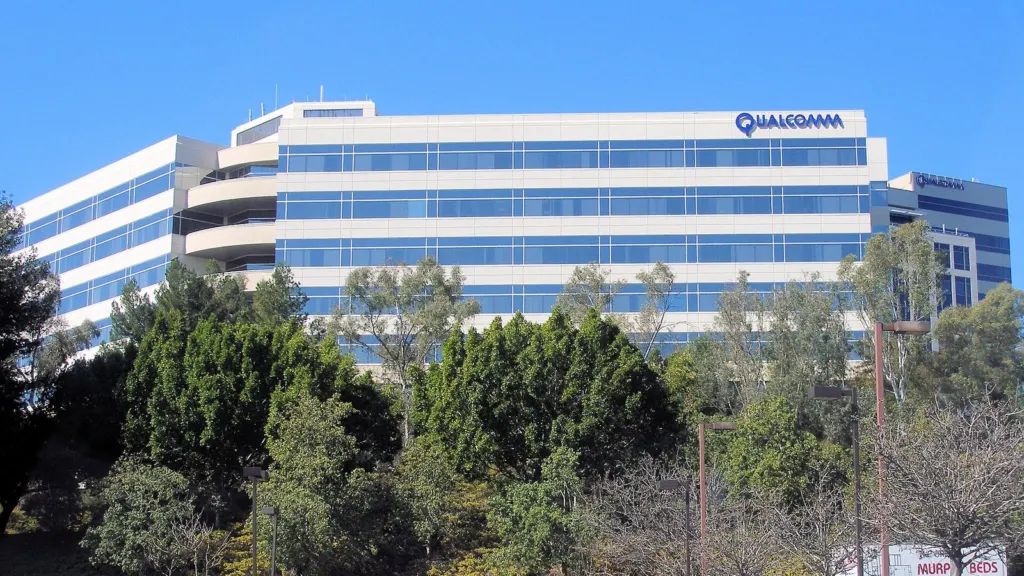
Photo: Coolcaesar at en.wikipedia, CC BY-SA 3.0, via Wikimedia Commons.
Irwin Jacobs, a former engineering professor at UC San Diego, founded Qualcomm in 1985 with Andrew Viterbi and five others. Their first product was OmniTRACS, a satellite messaging and tracking system for trucking companies. The company’s big bet was on CDMA, a way of carrying many cellphone calls over the same frequencies that skeptics said would not work at scale.
It did. CDMA became a standard for mobile networks in the United States and elsewhere, and Qualcomm’s patents on it became the core of the business.
Chips and licensing
Qualcomm makes money two ways: selling chips, particularly the Snapdragon processors used in many Android phones, and licensing its patents to phone makers. The licensing model has led to legal battles with regulators and with Apple, which settled a large dispute with Qualcomm in 2019.
The company has pushed into chips for cars, laptops and connected devices, as smartphone sales have slowed.
The local footprint
Qualcomm’s campus on Morehouse Drive in Sorrento Valley is one of the largest employer sites in San Diego, and its success helped create a technology cluster of engineers and spinoffs. For two decades the city’s football stadium carried the Qualcomm name.
Jacobs and his wife Joan have given hundreds of millions of dollars to local institutions, including UC San Diego’s Jacobs School of Engineering. Qualcomm has had layoffs in recent years, but it remains one of the region’s most important private companies.
More in Business

xTool Officially Launches X1: An Upgradable Multi-Laser Platform Engineered for Speed, Versatility, and Business Growth
 By Marco Villaruz ·

The Coffee Bean & Tea Leaf® Launches Holiday Beverage Menu featuring Tiramisu Drinks and Seasonal Favorites
By Marco Villaruz ·


Rob Younger is handing Birkenstock of San Diego to his son and his longtime manager
By Marco Villaruz ·