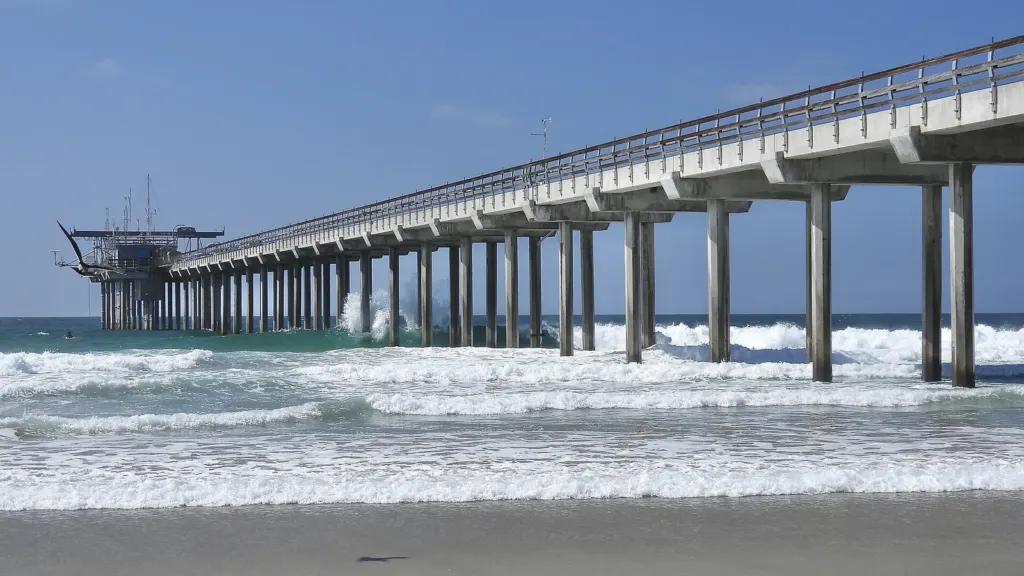
The Scripps pier in La Jolla Shores. Photo: Stch2022, CC0, via Wikimedia Commons.
The sewage that pours out of the Tijuana River doesn’t just foul the water at Imperial Beach. A new study from UC Riverside says some of the chemicals it carries can ride ocean currents up the coast and escape into the air as far north as La Jolla, about 22 miles from the river mouth.
The research, published in Scientific Reports and announced by the university on Nov. 3, tracked wastewater-linked compounds at four air-sampling sites between the border and the Scripps Institution of Oceanography pier. The team found that the pollution was traveling much farther than air currents alone could explain, about seven times farther than expected before becoming airborne.
“It was already known that compounds from this waste could enter the air, but we didn’t realize until now how far it could travel underwater before emerging,” said lead author Karolina Cysneiros de Carvalho, an atmospheric scientist who did the work at UCR and the National Center for Atmospheric Research. Co-authors included UCR’s William Porter and Kelley Barsanti and UC San Diego’s Kimberly Prather, whose lab has led much of the earlier work on sewage-linked aerosols in the South Bay.
A sulfur compound that shouldn’t have made it
The samples were collected in August and September 2024, during an unusual dry-season event. Summer flows in the Tijuana River normally drop close to zero. That year, between 160 million and 207 million liters of wastewater a day were still reaching the Pacific.
Researchers focused on dimethyl trisulfide, a sulfur compound tied to decomposing organic matter and sewage. They found it at all four sites, including La Jolla. That was a puzzle, because the compound breaks down quickly once it’s in the air. If it had blown up the coast on the wind, most of it should have been gone well before reaching Scripps.
“We found pollutants far from the source that couldn’t be explained by just the wind,” Porter said.
The clue came on Sept. 10, 2024, when a pump station started diverting wastewater south and the volume in the river dropped sharply. Dimethyl trisulfide readings in La Jolla fell 86% afterward, but some of it lingered for about two days. That lag suggested the pollution had been stored somewhere first.
The researchers concluded the ocean was doing the storing and the carrying. In seawater the compound lasts much longer than in air. Their modeling found that at a depth of about 10 meters, up to 76% of it could survive the roughly 35-kilometer trip north under the conditions they studied. Some chemicals can also cling to organic particles in the water and hitch a ride that way. Ocean measurements from the same period showed fresher water spreading north along the coast toward Del Mar, and circulation models showed currents running north.
It wasn’t one chemical. The team identified a group of volatile organic compounds that rose and fell with the wastewater tracer and with river flow.
What the study doesn’t say
The authors are careful about limits. They looked at an extreme dry-season discharge, and they don’t know yet how far the pollutants travel under more typical conditions or how seasons, winds and currents change the picture. The study also did not measure whether the concentrations they found are a health risk.
What it does do is challenge how air quality is modeled. Most models track pollution after it enters the atmosphere. This work suggests that rivers and the ocean can carry some compounds a long way before they ever get there, which could change where regulators expect people to be exposed.
“You can’t just shut down the beach and call it good,” Porter said. “We need to clean up the water not just for swimming but for breathing.”
The findings land as the long-promised fixes are finally under construction. We reported last month on how the South Bay plant expansion moved into heavy construction ahead of an expected El Niño winter. Beaches at Border Field State Park and the Tijuana Slough refuge remain closed, and advisories continue along much of the South Bay shoreline. If this study holds up, the communities with a stake in that work stretch a lot farther up the coast than the beaches with closure signs.
 By
 By