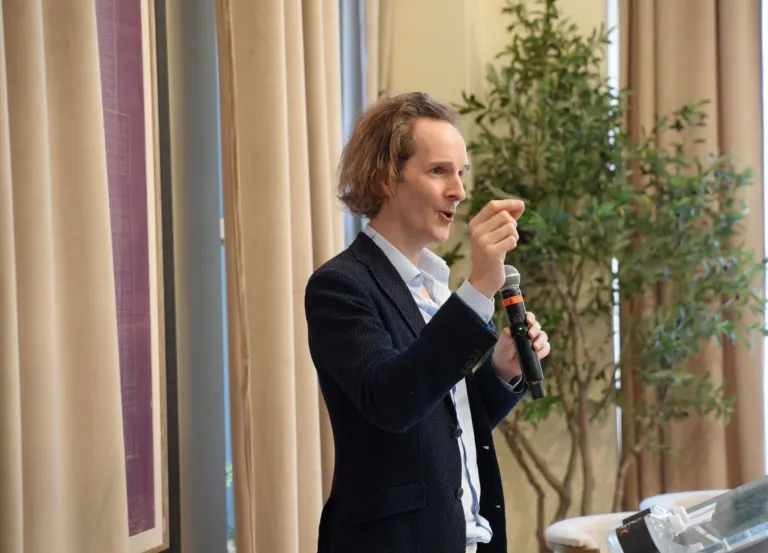
Paul E. Jacobs at the World Economic Forum in Davos in 2013, while he was Qualcomm's CEO. Photo: World Economic Forum from Cologny, Switzerland / Wikimedia Commons, CC BY-SA 2.0
Paul Jacobs spent most of his career at the company his father co-founded, and became the face of Qualcomm during the years smartphones went from novelty to necessity. These days the San Diego engineer runs a satellite company that is in the middle of being acquired by Amazon.
Jacobs, 64, has been chief executive of Globalstar since August 2023. The company is headquartered in Covington, Louisiana, but its terrestrial wireless business, built on technology from a startup Jacobs founded here, carries a San Diego dateline.
Growing up with Qualcomm
Jacobs is the son of Joan and Irwin Jacobs, the former UC San Diego professor who co-founded Linkabit and then Qualcomm in 1985. He earned three degrees from the University of California, Berkeley: a bachelor’s in electrical engineering and computer science, a master’s in electrical engineering and a Ph.D. in electrical engineering and computer science, finishing in 1989.
He joined Qualcomm in 1990 as an engineer in its wireless technology development group, at a time when the company was still trying to convince the industry that its CDMA approach to cellular networks would work. By 2001 he was president of the Qualcomm Wireless and Internet Group, and in July 2005 he took over as CEO.
His nine years in that job tracked the arrival of the modern smartphone. According to Globalstar’s announcement of his appointment, Qualcomm’s revenue grew from $5.7 billion to $25.7 billion while he was CEO, and the company added about $50 billion in market value. The company’s rise is told in more detail in our look at how Qualcomm turned San Diego into a wireless technology hub.
Jacobs became chairman in 2009, handed the CEO job to Steve Mollenkopf in March 2014 and served as executive chairman until 2018. He left the board that year after telling directors he was exploring an offer to buy the company. He is named on more than 80 U.S. patents, granted or pending, in wireless technology and devices, and was elected to the National Academy of Engineering in 2016.
XCOM Labs, then Globalstar
Later in 2018 he started over. Jacobs founded XCOM Labs in San Diego with two other former Qualcomm executives, Derek Aberle and Matt Grob, to work on next-generation wireless technology, according to the company. XCOM developed systems for dense 5G networks and wireless extended reality, aimed at customers in defense, entertainment, logistics and medical technology.
In August 2023, Globalstar named Jacobs its CEO and signed a perpetual, exclusive license to key XCOM technologies, including its XCOMP coordinated multipoint radio system. Grob came with him as Globalstar’s chief technology officer, along with other XCOM engineers. The startup that remained renamed itself Virewirx and now focuses on 60 GHz wireless networks for robotics and autonomous systems, under a different chief executive.
The XCOM work lives on inside Globalstar as XCOM RAN, a private 5G product that won a Gold Stevie Award for Technology Innovation of the Year in October.
A new constellation and a pending sale
Globalstar’s main business is satellites. It reported third-quarter revenue of $70.9 million on Nov. 5, along with the launch of its first batch of HIBLEO-4 replacement satellites, which keep its current network running. “These achievements are expected to strengthen the foundation of our satellite network as we prepare for the next era of connectivity,” Jacobs said in the earnings release.
The bigger project is C-3, a third-generation system of 48 low Earth orbit satellites plus six spares, designed to connect directly with ordinary phones. The FCC authorized it in October, and on Nov. 9 Globalstar said France had cleared it to launch and operate, bringing the number of countries that have authorized C-3 to more than 20. The company expects to start launching C-3 satellites next year.
All of that is now headed for new ownership. Globalstar agreed in April to merge with Amazon Leo, Amazon’s low Earth orbit satellite network, and the FCC approved Amazon’s application on Oct. 27. Globalstar says it expects the deal to close in 2027, subject to remaining regulatory approvals and satellite milestones.
Jacobs also sits on the board of chip designer Arm. For an engineer who joined Qualcomm in 1990 to work on cellular technology, the path from phones to satellites has been a short one: the C-3 system is, at bottom, an effort to make sure the phone in your pocket still works when there is no tower in sight.
 By